Commercial Trailer Air Brake System Repair & Troubleshooting
For commercial fleets operating across Nova Scotia, New Brunswick and beyond, trailer brakes need to do more than stop the load—they need to work consistently, efficiently and predictably every time the driver applies the brakes.
A small air leak, excessive slack adjuster travel or an ABS fault can become much more than an inconvenience. Brake problems can contribute to uneven stopping, accelerated component wear, roadside inspection violations and, in serious cases, an out-of-service condition.
That makes timely commercial trailer brake repair service an important part of fleet maintenance—not something to leave until a warning light appears or a trailer fails an inspection.
The good news is that many trailer brake problems leave recognizable clues. Knowing what to look for can help drivers and fleet maintenance managers identify a developing problem before it becomes a major repair.
The Core Elements of Semi-Trailer Air Brake Infrastructure
A commercial trailer air brake system is a network of pneumatic and mechanical components that must work together.
Compressed air travels from the tractor to the trailer through the air connections, commonly referred to as gladhands. From there, valves control and distribute air pressure to the brake chambers. The brake chamber converts pneumatic pressure into mechanical movement through its pushrod.
The pushrod operates the automatic slack adjuster, which transfers movement to the S-cam. The S-cam rotates and forces the brake shoes against the drum.
At the same time, the trailer’s ABS system monitors wheel speed and can modulate braking to help prevent wheel lockup.
The major components include:
- Gladhands and seals: Connect the tractor and trailer air systems.
- Air lines and fittings: Carry compressed air throughout the system.
- Relay valve: Allows air to reach the brake chambers quickly, helping provide faster brake application and release.
- Brake chamber: Converts air pressure into mechanical movement.
- Brake chamber diaphragm: Separates the air side of the chamber and can leak or fail with age or damage.
- Automatic slack adjuster: Maintains the appropriate relationship between brake shoe position and the brake chamber pushrod.
- S-cam: Converts rotational movement into the outward movement that applies the brake shoes.
- S-cam bushings: Support the camshaft and allow it to rotate correctly.
- Brake shoes and linings: Create friction against the brake drum.
- ABS sensors and tone rings: Monitor wheel rotation and provide information to the ABS controller.
Canadian federal Motor Vehicle Safety Regulations include requirements for air-braked trucks, buses and trailers under Standard 121. (Transport Canada).
Because all these components interact, a symptom at one location doesn’t necessarily mean that component is the original cause. A thorough inspection looks at the entire brake system.
Common Trailer Brake Failure Modes and Diagnostic Signals
A trailer that pulls to one side, takes longer to stop, develops an air leak or has unusually hot wheels shouldn’t simply be put back into service.
The symptom can provide the starting point for diagnosis:
- If you hear air hissing around a gladhand, inspect the gladhand seal, connection and hose. A damaged or poorly seated seal can allow air to escape and contribute to air-pressure loss.
- If you hear air leaking near a brake chamber, the chamber, diaphragm or fittings should be inspected. A damaged brake chamber diaphragm can prevent the chamber from maintaining proper air pressure.
- If the brakes are applying slowly, the relay valve, air lines and fittings should be checked for restrictions, contamination or other problems. A malfunctioning relay valve can interfere with the rapid delivery of air needed for normal brake application.
- If one wheel is significantly hotter than the others, investigate brake adjustment, the lining, S-cam and related mechanical components. Excessive heat can be a sign that a brake is dragging rather than releasing completely.
- If brake linings are wearing unevenly, look beyond the friction material itself. Uneven wear can point to problems with adjustment, the slack adjuster, S-cam, bushings or other wheel-end components.
- If the pushrod or slack adjuster has excessive travel, the brake adjustment and mechanical components need to be checked. Excessive travel can reduce effective braking performance.
- If the ABS indicator lamp remains illuminated, the ABS system should be scanned and inspected. Possible causes include a wheel-speed sensor, wiring, tone ring, modulator or controller problem.
- If the brakes grab or lock, the cause could be mechanical binding, contaminated brake linings, moisture in the air system or an ABS-related problem. The specific cause needs to be identified before the trailer is returned to service.
The important point is that these symptoms are clues, not diagnoses. Several different faults can produce similar symptoms, which is why professional inspection is important when a problem persists.
Air Leaks at the Gladhand Seals and Relay Valves
One of the easiest trailer brake problems to detect is also one that shouldn’t be ignored: an audible air leak.
Start with the connections between tractor and trailer.
Damaged or improperly seated gladhand seals can allow compressed air to escape. A worn seal may be inexpensive to replace, but continuing to operate with an air leak can create larger problems if system pressure cannot be maintained.
Technicians should also inspect hoses, fittings, valves and brake chambers.
A particularly important component is the relay valve. Because the relay valve controls the flow of air to the trailer brake chambers, a problem can affect brake application and release.
A leaking brake chamber can also point to a damaged brake chamber diaphragm. In that situation, the chamber may fail to maintain air pressure properly.
CVSA inspection guidance makes an important distinction around air leaks: an audible leak can be a violation, and certain leaks or air-loss conditions can result in an out-of-service determination. Its 2026 inspection bulletin specifically notes that an audible leak at a location that cannot be tightened—or elsewhere in the air line—is an out-of-service condition, while any detected brake-system leak can trigger an air-loss test. (CVSA).
That means “it’s only a small leak” isn’t a good maintenance strategy.
Excessive Slack Adjuster Travel and S-Cam Structural Binding
The automatic slack adjuster is designed to maintain proper brake adjustment as the friction material wears.
But automatic doesn’t mean maintenance-free.
Excessive movement at the slack adjuster can indicate problems with the brake system, including incorrect adjustment, worn components or mechanical issues elsewhere in the wheel-end assembly.
The S-cam bushings deserve particular attention. If bushings wear excessively, the camshaft may not remain properly aligned. The result can be uneven brake shoe movement, abnormal lining wear or ineffective brake application.
Other warning signs include:
- Uneven brake lining thickness
- One brake shoe wearing faster than another
- Excessive slack adjuster movement
- Visible mechanical damage
- Brake drag
- Difficulty releasing the brake
- Unusual heat at one wheel end
A technician should inspect the entire mechanism rather than simply adjusting the slack.
If the underlying problem is worn S-cam bushings, a quick adjustment won’t solve the problem.
Demystifying Trailer ABS Warning Light Diagnostic Fault Codes
The ABS indicator lamp is another valuable diagnostic tool.
When the trailer ABS lamp illuminates, it is telling you that the system has detected a fault. The precise meaning depends on the trailer’s ABS manufacturer and diagnostic system.
Common areas of investigation include:
- Wheel-speed sensors
- Sensor wiring and connectors
- Tone rings
- ABS modulators
- Power supply
- Ground connections
- ECU/controller faults
- Damaged or incorrectly positioned sensors
A warning lamp shouldn’t automatically be interpreted as “the brakes don’t work.” The conventional air brake system may still apply the brakes, but the ABS function may be compromised.
That’s why ABS indicator lamp codes need to be diagnosed rather than simply cleared.
A technician can retrieve the applicable fault information, inspect the affected wheel end and determine whether the problem is electrical, mechanical or sensor-related.
This is especially important before a long haul. An ABS warning that appears shortly after leaving the shop—or halfway through a trip—can turn a manageable repair into a roadside service call.
Preparing for the CVSA Roadcheck: Out-of-Service Trailer Air Brake Criteria
Roadside inspections are not limited to annual maintenance schedules.
The CVSA International Roadcheck is one of the most visible inspection campaigns for commercial carriers in North America, but the inspection standards apply throughout the year. In 2026, CVSA’s International Roadcheck ran May 12–14, with inspectors using the North American Standard inspection procedures and out-of-service criteria. (CVSA).
The 2026 North American Standard Out-of-Service Criteria took effect April 1, 2026. CVSA updates these criteria annually, so fleets should make sure they’re working from the current edition rather than relying on an old checklist. (CVSA).
Brake systems are a major inspection concern.
CVSA’s brake inspection guidance addresses issues including defective brakes, brake adjustment, air hoses and other brake-system defects. The criteria can include thresholds for defective brakes and adjustment depending on the vehicle and brake configuration. (CVSA).
The practical takeaway for fleets is straightforward: Don’t maintain your trailer brakes only to the point where they barely pass inspection. Maintain them so developing problems are identified before the inspection.
For Canadian fleets, provincial enforcement and applicable federal/provincial requirements also matter. A carrier operating between New Brunswick, Nova Scotia and other jurisdictions should make sure its maintenance program accounts for the requirements applicable to its equipment and operations.
CVSA’s 2026 Brake Safety Day results illustrate why brake maintenance deserves attention: Canadian inspectors recorded 112 brake-related out-of-service violations among 716 inspections during that campaign, a 15.6% brake OOS rate. (CVSA).
The exact out-of-service determination depends on the applicable criteria and the conditions found during the inspection.
What a Professional Trailer Brake Inspection Should Cover
A good inspection goes beyond looking for a worn brake shoe.
A technician should assess the system from the air supply through the wheel ends, including:
- Air supply and connections: Check gladhands, seals, hoses, fittings and air-loss behaviour.
- Brake chambers: Inspect for damage, mounting issues and diaphragm leakage.
- Slack adjusters: Verify operation and appropriate adjustment.
- S-cams and bushings: Look for wear, binding, misalignment and excessive movement.
- Brake shoes and drums: Check lining condition, thickness, contamination, cracking and wear patterns.
- ABS: Scan for diagnostic faults and inspect sensors, wiring and related components.
- Wheel ends: Investigate abnormal heat or evidence of brake drag.
This approach is especially important when a symptom keeps returning.
For example, if a trailer repeatedly develops uneven lining wear, simply replacing the shoes may not solve the problem. The technician should investigate the slack adjuster, S-cam, bushings, chamber and related components to identify why the wear occurred.
Express Trailer Preventive Maintenance Options at Rhino Centres
For fleet managers, preventive maintenance is ultimately about reducing downtime.
A trailer that enters the shop for a routine inspection can often be evaluated before a minor brake-system issue becomes an emergency repair. Catching a leaking gladhand seal is easier than dealing with a trailer that cannot maintain air pressure. Identifying S-cam bushing wear is preferable to discovering a binding brake after the wheel end overheats.
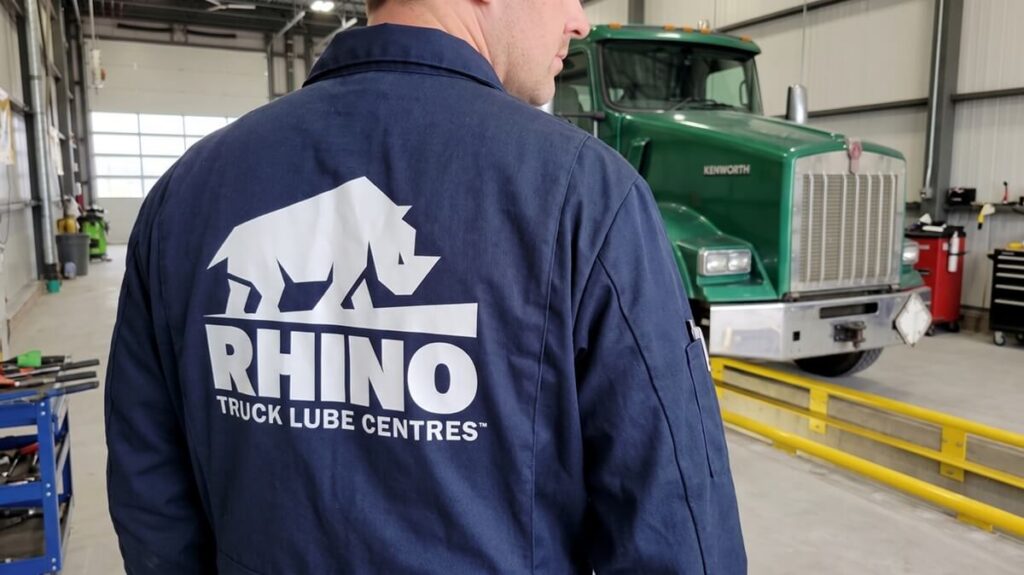
Rhino Truck Lube Centres can help fleets incorporate trailer brake and air-system checks into their maintenance routines.
If you need more extensive work, explore Rhino’s trailer repair and service options. Preventive maintenance can also be incorporated into a broader commercial vehicle maintenance program.
The objective isn’t simply to get a trailer through the next inspection.
It’s to keep the equipment working reliably between inspections.
Frequently Asked Questions
Don’t Wait for the Inspection to Find the Problem
Trailer air brake systems are engineered to work as a complete system. A leaking gladhand, worn S-cam bushing, damaged chamber diaphragm or ABS sensor fault can affect more than one component—and symptoms aren’t always obvious from the driver’s seat.
For fleets operating across Atlantic Canada, a proactive brake inspection can help identify problems before they become costly downtime, roadside repairs or compliance issues.
Keep your trailing equipment compliant and running smoothly. Roll into Rhino Truck Lube Centres for precision commercial trailer air system maintenance and repairs today.